Buyer's guide / AIO coolers
The best AIO coolers of 2026
Five 360 mm AIOs for five different builders: the consensus value+performance winner, the LCD display for creators, the iCUE-Link cable cleanup, the RGB showpiece, and the budget cooler that beats coolers twice its price.
By Evan Cole · Last updated August 7, 2026
A 360 mm AIO is the right CPU cooler for almost every workstation we'd build today. It handles a Ryzen 9 9950X3D or a Core Ultra 9 285K with quiet headroom to spare, leaves room above the CPU socket for tall RAM or VRM heatsinks, and -- the part that's changed in the last two years -- the entry price is now genuinely reasonable. The cooler we'd recommend at the top of the list sits in the value tier.
We picked five AIOs for five different builds. If you want the one-paragraph answer, skip to The bottom line. If you want the right cooler for your case, your CPU, and your aesthetic priorities, the five picks below cover every reasonable 360 mm AIO in 2026.
Updated August 2026. Prices re-checked and picks re-verified against the latest independent testing. The big 2026 change: Arctic's Liquid Freezer III Pro (September 2025) — faster P12 Pro fans and A-RGB on the same 38 mm radiator and VRM fan — is now our top pick. See the note under it, and the FAQ, for when the cheaper standard III is still the smarter buy.
The verdict, at a glance
Best overall
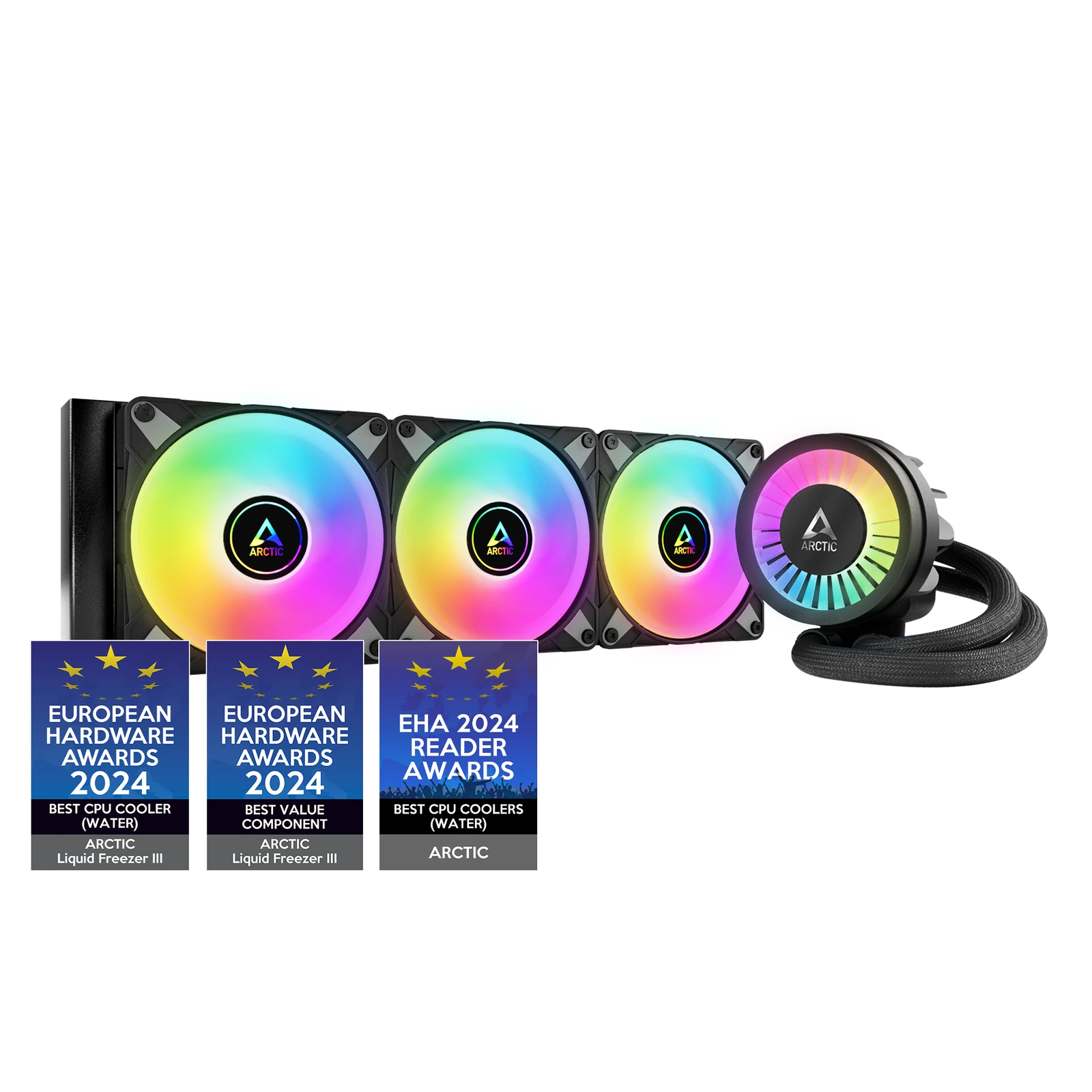
Arctic Liquid Freezer III Pro 360 A-RGB
The 2026 value+performance consensus pick — 3-8°C cooler than rivals at the same noise, with a real integrated VRM fan.
Best for creators (LCD)
The AIO display done right — a sharp 2.72-inch LCD that reads like a small second monitor for creators.
Best cable management
Corsair iCUE Link Titan 360 RX RGB
The cable cleanup — the iCUE Link daisy-chain drops nine cables behind the board to one.
Best aesthetics / RGB
Lian Li Galahad II Trinity Performance 360
The RGB showpiece that still cools — a beautiful infinity-mirror pump head on an Asetek-derived platform.
Best budget
The budget cooler that embarrasses mid-tier AIOs — within 3-5°C of premium picks under load, with a 5-year warranty.
How we picked
AIO cooler recommendations are easier than they should be, because the market has consolidated around a handful of platforms that all work and a long tail of mediocre ones that all don't. VerdictBits weighs four signals:
- Thermals under sustained load, not peak boost. A cooler that runs a Cinebench R23 multi-thread loop for 30 minutes at 8 degrees lower than the competition is the cooler we want. Peak single-thread benchmarks don't separate AIOs anymore -- everything reasonable handles a 5-second boost.
- Pump and fan noise at idle and under load. Workstations live next to a microphone half the day. The gap between "quiet at idle, audible under load" and "audible at idle, loud under load" is where most cheap AIOs end up. We weight noise floor as heavily as raw thermal performance.
- Warranty and pump reliability. The pump is the failure point on every AIO ever built. Arctic ships 6 years, ID-COOLING ships 5. The brands that ship 2-3 are quietly telling you their pumps last 3 years. Believe them.
- Cable and accessory ecosystem. The iCUE Link, L-Connect 3, and similar daisy-chain systems aren't gimmicks -- they materially reduce the cable count behind the motherboard and improve airflow. The trade-off is vendor lock-in for future fans. Worth knowing before you buy.
A note on how to read cooler benchmarks: the number that matters is noise-normalized performance — the temperature a cooler holds when every cooler in the test is locked to the same loudness (most 2026 labs pin their AIOs to around 36-40 dBA). Raw "coolest temperature" charts mislead, because a cooler can win simply by spinning its fans louder. When we say the Arctic runs cooler "at the same noise level," that noise-normalized framing is exactly what we mean. We lean on the labs that publish it — Tom's Hardware, TechPowerUp, GamersNexus, KitGuru — read delta-over-ambient rather than absolute temperature so a warm test room can't skew the ranking, and weight a sustained all-core load (a 30-minute Cinebench loop is the standard) over a short peak boost.
We do not accept payment to recommend products. See our affiliate disclosure for how VerdictBits is funded, and our methodology page for the rest of our editorial standard.
1. Arctic Liquid Freezer III Pro 360 — Best overall
— VerdictBits editorial score
Reasons to buy
- 3-8°C cooler than other 360mm AIOs at equal noise
- 38 mm radiator — more heat-dumping surface
- Integrated 40 mm VRM fan cools the socket VRM
- 6-year warranty at value-tier money
Reasons to avoid
- 38 mm radiator thicker than most cases expect
- Plain black next to the RGB picks
- May need top-mount pull-up if clearance is tight
For: almost everyone. The Arctic Liquid Freezer III is the AIO we'd recommend to a friend without asking another question, and the AIO we'd put in our own workstation if cost mattered at all.
The Liquid Freezer III earns its place at the top of the list for a simple reason: it consistently runs 3-8°C cooler than other 360 mm AIOs at the same noise level, under sustained CPU loads, in every independent thermal test we trust (Tom's Hardware, TechPowerUp, GamersNexus). The reason is mechanical, not magical -- the radiator is 38 mm thick instead of the standard 27 mm, which gives the coolant more surface area to dump heat. The Pro's P12 Pro fans push more air than the reference P12 the rest of the industry compares itself to, and the integrated 40 mm VRM fan that sits on the pump head genuinely cools the VRM around the CPU socket (the part of your motherboard that gets hot but doesn't have a fan over it on any other AIO).
The 6-year warranty is the longest in the AIO category by a meaningful margin. Arctic pays out on RMAs without arguing. We've seen 7-year-old Arctic CPU coolers still running with the pump intact.
You're looking at the Pro. Arctic released the Liquid Freezer III Pro in September 2025 — the same 38 mm radiator and integrated VRM fan as the original III, with faster P12 Pro fans and A-RGB added, and it's the model most 2026 reviewers now rank first. It supports LGA1851 / LGA1700 and AM5 / AM4 (the Pro drops the older LGA1200 bracket the standard III still carries), and comes in black or white. One honest caveat: a couple of hands-on benches put it mid-pack rather than first, and its street price swings with sales, so if you find the standard Liquid Freezer III meaningfully cheaper, buy that instead — the two cool almost identically.
The catches are real but small. The 38 mm radiator is thicker than most cases anticipate -- check your case's roof clearance before ordering, and budget for top-mount with the fans pulling up rather than push-pull through the radiator if clearance is tight. The black Liquid Freezer III is plain-looking next to the RGB picks below. If you specifically want a showpiece cooler, the Galahad II below is the right answer. If you want the cooler that keeps your CPU coolest at the lowest noise floor and the lowest price, this is it.
Check current price on Amazon.
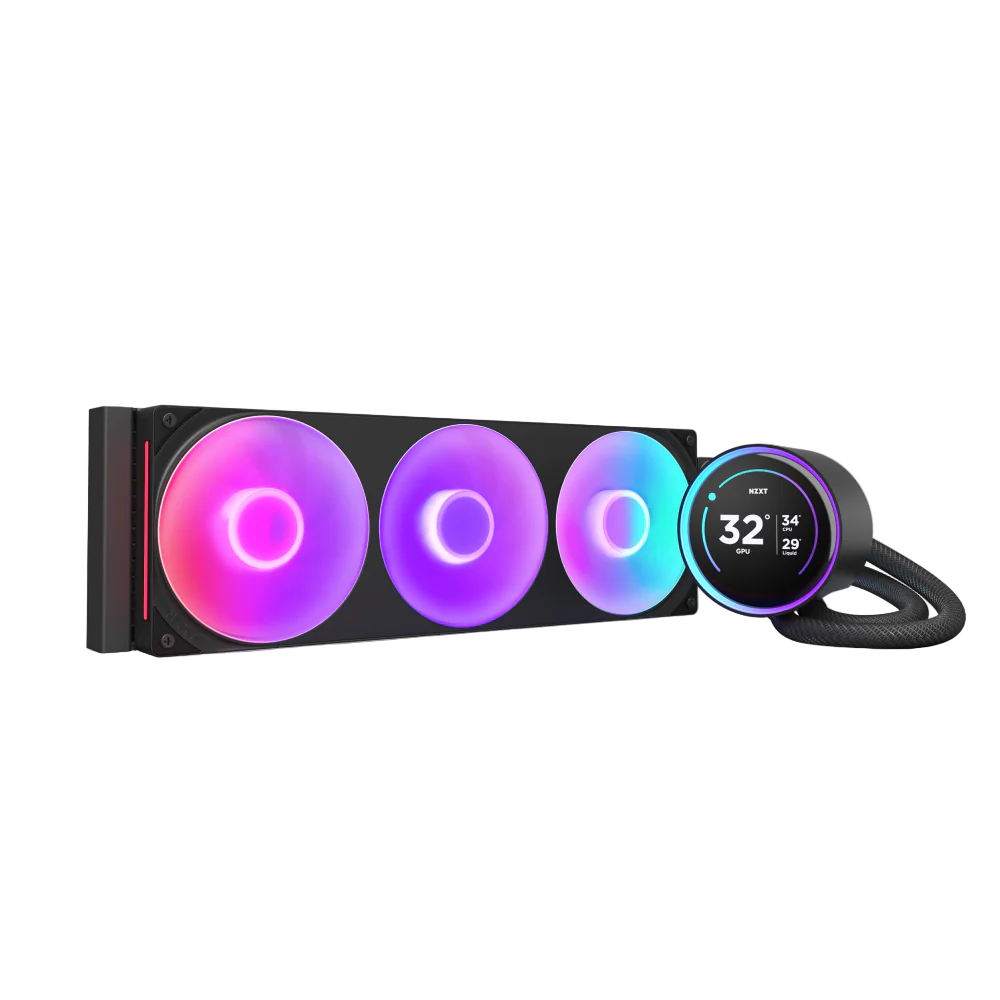
2. NZXT Kraken Elite 360 — Best for creators (LCD)
— VerdictBits editorial score
Reasons to buy
- 2.72-inch 640×640 IPS LCD, 660 nits
- Glanceable CPU temp / clock / render queue
- Attractive pump-head RGB with the LCD off
- Thermals stay clear of throttling
Reasons to avoid
- Flagship-priced — several tiers above the Arctic
- CAM software is the weakest part
- A few degrees behind the Arctic on thermals
- F120 fans not class-leading on noise
For: video editors, streamers, 3D artists, and anyone whose workflow benefits from glanceable system data without a second monitor.
The Kraken Elite's 2.72-inch 640×640 IPS LCD on the pump head is the AIO display done right. It is sharp, it is bright (660 nits), and it is large enough that the CPU temperature, system clock, animated GIF, or live render-queue status is actually readable from across the desk. NZXT's CAM software is the weakest part of the package (it occasionally needs a kick), but the display itself is the closest thing to "small second monitor" we've seen on an AIO.
Thermal performance lands a few degrees behind the Arctic Liquid Freezer III in independent tests but stays well within the band where sustained-load throttling never kicks in for any current consumer CPU. The F120 RGB Core fans are solid -- not class-leading on noise but well-tuned out of the box -- and the integrated RGB lighting on the pump head is among the most attractive in the category if you turn the LCD off.
The cost question is the real one. At flagship money, the Kraken Elite is several tiers above the Arctic. You are paying for the display. Whether that math works depends on whether you'll actually use it -- in our experience, the LCD is the kind of thing that's a gimmick on a pure-gaming PC and a real workflow utility on a creator workstation where checking render progress or thermal headroom mid-export matters.
Check current price on Amazon.
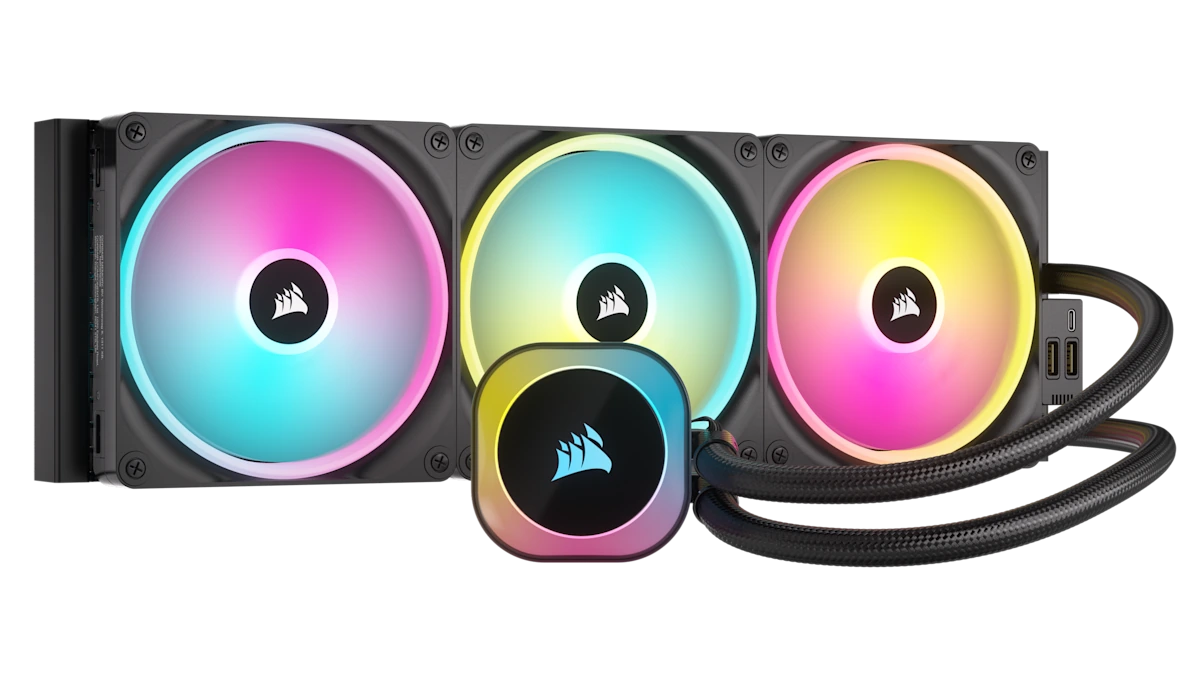
3. Corsair iCUE Link Titan 360 RX RGB — Best cable management
— VerdictBits editorial score
Reasons to buy
- Single-cable daisy-chain — ~9 cables to one
- Dramatic in a glass-side case
- RX RGB fans quieter than previous LL fans
- iCUE better-maintained than CAM; LCD variant
Reasons to avoid
- Proprietary — future fans must be iCUE Link
- Ecosystem lock-in
- A few degrees behind the Arctic
- Premium priced
For: builders who care about how the inside of the case looks as much as how it performs, and anyone who's ever cursed while trying to route nine cables behind a motherboard tray.
The iCUE Link Titan's reason to exist is the single-cable daisy-chain. Each iCUE Link fan and pump connects to the next with one short proprietary cable; the whole chain returns to the System Hub on a single longer cable, and the System Hub connects to the PSU and the motherboard. The cable count behind the motherboard drops from typically nine cables (three fan PWM + three RGB + one pump PWM + one pump RGB + one system hub) to one. The difference inside a glass-side case is dramatic.
The trade-off is real and worth knowing about. iCUE Link is a proprietary Corsair ecosystem. Every fan you add to this AIO in the future has to be an iCUE Link fan, not a standard PWM fan. Once you commit to iCUE Link, you're committing to Corsair fans for the rest of the build. Some builders love that (one app, one ecosystem); some will find it claustrophobic.
Thermal performance is competitive with the Kraken Elite -- a few degrees behind the Arctic, well ahead of the budget tier. The RX RGB fans are quieter than the previous-generation Corsair LL fans at the same RPM and look better with the lights off. The iCUE software is better-maintained than NZXT's CAM and has a cleaner per-component control surface for fan curves and lighting profiles.
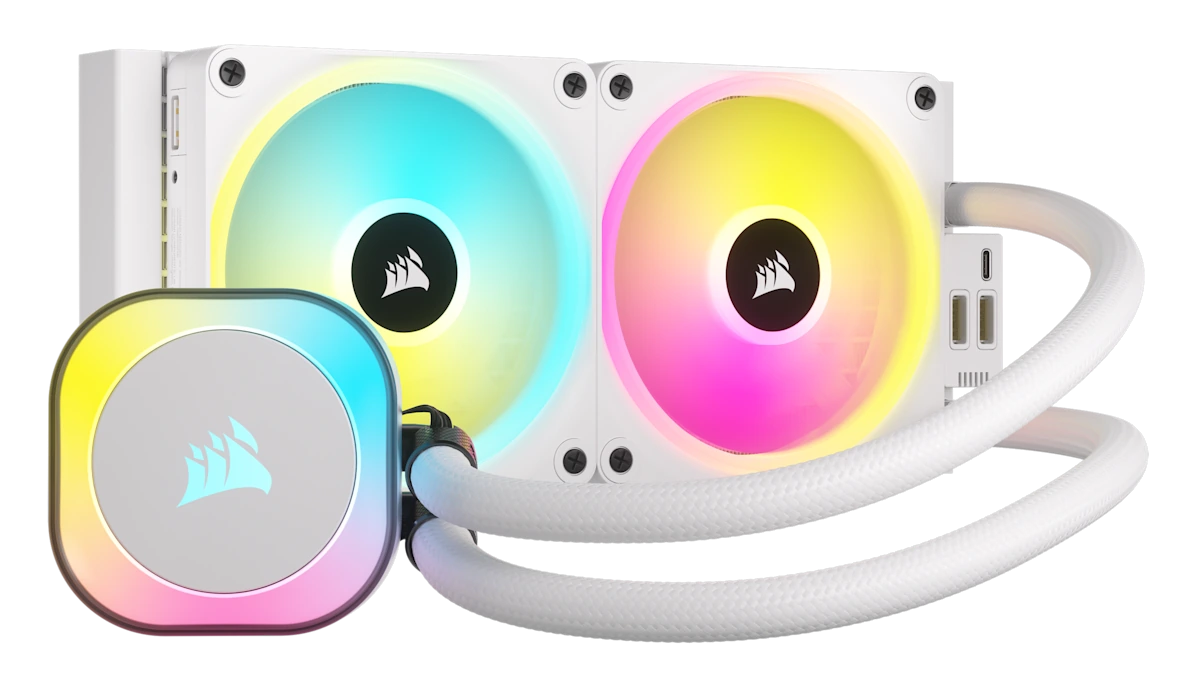
Premium upgrade: the iCUE Link Titan 360 RX LCD variant swaps the plain pump cap for a customizable IPS display -- recommended if you've already committed to the iCUE Link ecosystem and want CPU temperature, clocks, or an animated logo on the cooler itself. It runs a clear step up over the standard RX RGB model.
Check current price on Amazon.
4. Lian Li Galahad II Trinity Performance 360 — Best aesthetics / RGB
— VerdictBits editorial score
Reasons to buy
- Infinity-mirror pump head — beautiful at any setting
- Uni Fan SL Infinity carry the look
- Thermals ahead of Corsair and Kraken for less
- Performance SKU adds P28 fans
Reasons to avoid
- Uni Fan ecosystem lock-in
- Smaller ecosystem than Corsair's
- Loses a few degrees to the Arctic
- P28 fans trade glow for throughput
For: showcase builds in glass-side cases, anyone who's invested in the Lian Li Uni Fan ecosystem, and builders who want the AIO to be the visual centerpiece of the workstation.
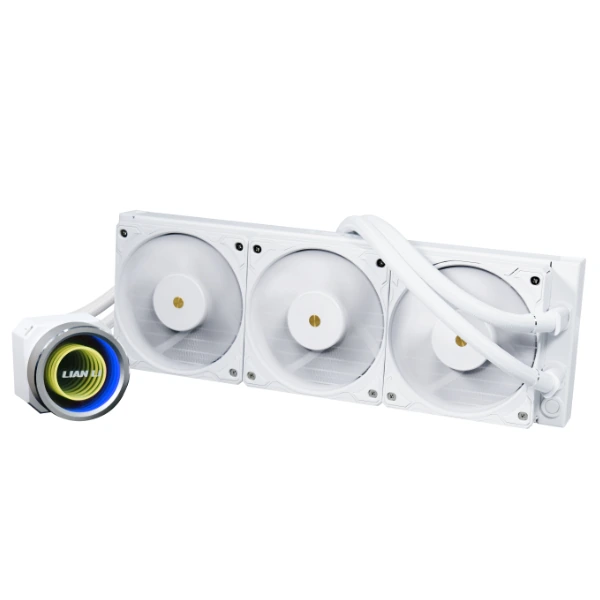
The Galahad II Trinity Performance is the AIO we'd recommend if RGB is half the reason you're building the PC in the first place. The infinity-mirror pump head is genuinely beautiful at any setting -- not the cheap concentric-ring effect that most RGB pumps ship with -- and the Uni Fan SL Infinity fans on the radiator carry the same visual language across the build. The L-Connect 3 controller pairs over USB and the per-fan and per-zone lighting control is some of the better software in the category.
The reason "RGB pick" doesn't necessarily mean "compromise on thermals" is that the Galahad II's pump platform is the same Asetek-derived design Lian Li shares with several of the high-end OEM coolers. Thermal performance lands ahead of the Corsair and Kraken Elite for a meaningfully lower price, while losing only a few degrees to the Arctic Liquid Freezer III. The Performance SKU swaps in Lian Li's P28 high-static-pressure fans (over the SL Infinity) for better radiator throughput at the cost of a slightly duller fan glow.
The downside is the Lian Li Uni Fan ecosystem lock-in is similar in flavor to Corsair's iCUE Link -- if you build out the rest of the case with Uni Fans, you commit to the Uni Fan controller and daisy-chain pattern. Lian Li's ecosystem is smaller than Corsair's but generally better-tuned for builders who care more about how things look than how many SKUs are available.
Check current price on Amazon.
5. ID-COOLING FX360 PRO — Best budget
— VerdictBits editorial score
Reasons to buy
- Within 3-5°C of Kraken/iCUE Titan under load
- 5-year warranty — rare at this price
- ARGB variant adds lighting for a small step up
- Budget tier
Reasons to avoid
- Fans louder at full RPM than premium picks
- Weakest software in the category
- No daisy-chain cable management
- Mediocre paste — budget a tube to replace it
For: first-time AIO buyers, builders on a tight budget, and anyone unwilling to pay mid-tier money for a 360 mm cooler when a budget one performs nearly as well.
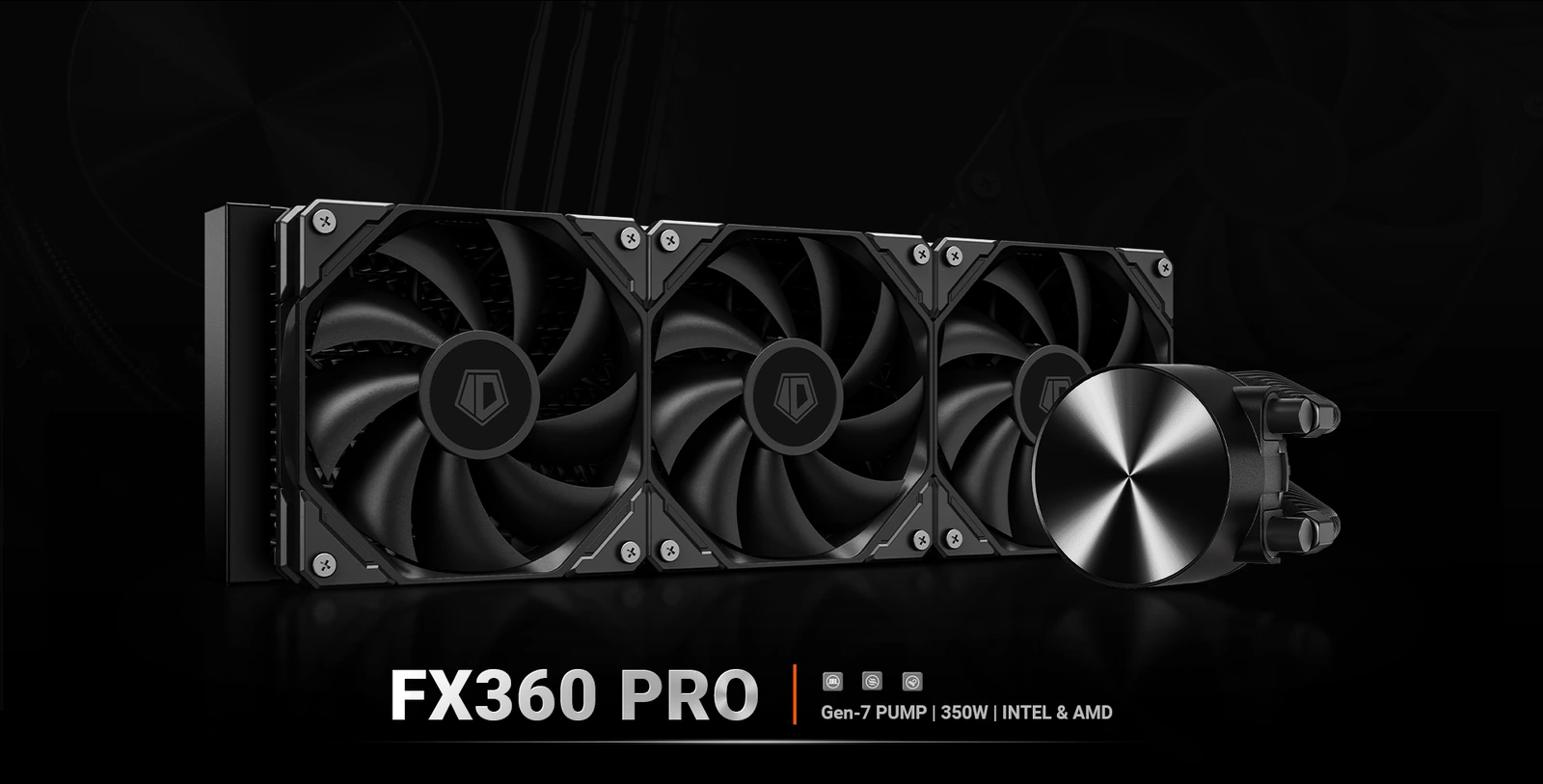
The ID-COOLING FX360 PRO is the budget pick that quietly embarrasses most mid-tier AIOs. Independent thermal tests at TechPowerUp and GamersNexus consistently show the FX360 PRO landing within 3-5 degrees of the much more expensive Kraken Elite and iCUE Link Titan under sustained Cinebench loads. The fans are louder at full RPM than the premium picks above -- this is where the cost savings come from -- but the noise gap closes considerably at 70-80% fan speeds, which is where most ambient-cooled CPUs run anyway.
The 5-year warranty is the surprise. Most budget AIOs ship 2-3 year warranties; ID-COOLING ships 5 on this model. We've seen FX-series coolers from previous generations still running with the pump intact in year four, so the warranty isn't just marketing.
The ARGB variant adds basic addressable lighting on the fans and the pump head for a small step up. It's not class-leading aesthetics -- the lighting is uniform, not zonal, and the fan blades aren't translucent -- but it's a meaningful step up from a no-lights black AIO for the price.
Trade-offs: the software (if you want fan and RGB control beyond your motherboard's headers) is the weakest in the category. There's no daisy-chain cable management -- you're back to standard three-fan + RGB header runs. And the included thermal paste is mediocre; budget for a proper tube of Arctic MX-6 or Noctua NT-H2 when you order the cooler.
Check current price on Amazon.
The five picks, side by side
| Cooler | Price tier | Radiator | Socket | Extras | Standout |
|---|---|---|---|---|---|
| Arctic Liquid Freezer III Pro 360 A-RGB | Value tier | 360 mm, 38 mm thick (chunkier than most) | AM5 / AM4 / LGA 1851 / LGA 1700 | Integrated VRM fan + A-RGB + 6-year warranty | The 2026 value+performance consensus pick across nearly every reviewer; the integrated VRM fan is real, not marketing |
| NZXT Kraken Elite 360 (RGB) | Flagship tier | 360 mm, 27 mm thick | AM5 / AM4 / LGA 1851 / LGA 1700 | 2.72-inch 640×640 IPS LCD on the pump head + CAM software | A real display, not a 1-inch novelty: GIF/clock/CPU temp/system stats visible without a second monitor |
| Corsair iCUE Link Titan 360 RX RGB | Premium tier | 360 mm, 27 mm thick | AM5 / AM4 / LGA 1851 / LGA 1700 | iCUE Link daisy-chain single-cable system + System Hub | One cable to the System Hub replaces the rat's-nest of three fan cables + three RGB cables + a pump cable |
| Lian Li Galahad II Trinity Performance 360 | Upper-mid tier | 360 mm, 27 mm thick | AM5 / AM4 / LGA 1851 / LGA 1700 | Infinity-mirror RGB pump head + L-Connect 3 controller + Uni Fan ecosystem | If RGB is half the reason you're building, this is the AIO that earns it — and it cools well |
| ID-COOLING FX360 PRO | Budget tier | 360 mm, 27 mm thick | AM5 / AM4 / LGA 1851 / LGA 1700 | 5-year warranty, ARGB lighting included on the PRO SKU | Outperforms several mid-tier AIOs in independent TechPowerUp and GamersNexus thermal tests; the warranty is what you'd expect a tier up |
What we considered but didn't pick
Three coolers came close to making the list and got cut for specific reasons worth naming:
- Arctic Liquid Freezer III 420 — arguably the best-performing AIO on the market in 2026, period. We didn't put it at #1 because 420 mm radiators only fit in select cases and the mounting complexity is meaningfully higher than 360. If your case can accept a 420 mm radiator, this cooler beats the 360 by another 3-5 degrees. For most builders, the 360 is the right answer.
- Corsair Nautilus 360 RS — an excellent quiet cooler at a more reasonable price than the iCUE Link Titan, but we cut it because the thermal headroom is meaningfully smaller and the RS line doesn't ship with the iCUE Link daisy-chain (the cable-cleanup we picked the Titan for in the first place).
- Asus ROG Ryujin III 360 ARGB — the 1.77-inch LCD pump head competes directly with the Kraken Elite at a similar price, but the smaller screen is meaningfully less useful than NZXT's 2.72-inch panel for the workflow use cases that justify a pump-head display in the first place.
Buying advice
Four things worth thinking about before you click buy:
- Check the radiator thickness against your case. The Arctic Liquid Freezer III's 38 mm radiator is thicker than the 27 mm standard most cases anticipate. If you're roof-mounting in a mid-tower with limited clearance above the motherboard, measure first or plan to front-mount as intake.
- Replace the thermal paste -- always. Every AIO ships with thermal paste pre-applied or in a small tube. Most of it is mediocre. A decent tube of Arctic MX-6, Noctua NT-H2, or Thermal Grizzly Kryonaut gets you 2-4 degrees on the same cooler with the same fan curve. Worth the trip.
- Don't buy iCUE Link or L-Connect without committing to the ecosystem. The daisy-chain cable advantage only works if every fan in your case is the same ecosystem. Buying a mixed-vendor case fan setup with an iCUE Link AIO defeats the cable-cleanup point.
- Check pump RPM in your motherboard BIOS. Most AIOs default to 100% pump speed which is unnecessarily loud. Drop pump speed to 70-80% in BIOS or motherboard software; thermals change by 1-2 degrees at most, noise drops meaningfully.
Compare retailers: our picks link to Amazon — it's also worth cross-checking current AIO cooler prices on Newegg →.
Which AIO for which CPU
The most common way this question goes wrong is comparing the wrong numbers. AMD and Intel do not mean the same thing by their headline wattage. AMD quotes a TDP; the figure a cooler actually has to dissipate is bounded by PPT, its socket-power limit. Intel quotes Processor Base Power and Maximum Turbo Power, and it is the turbo figure that sizes the cooler. So reading a Ryzen 9 9950X3D as a "170 W" chip and a Core Ultra 9 285K as a "250 W" chip compares a TDP against a turbo limit. Ceiling to ceiling it is 200 W against 250 W — still not the same quantity as each other, but close enough to size a cooler and not close enough to claim one chip runs hotter.
| CPU | Vendor headline | Published max power | Why it is easy or hard |
|---|---|---|---|
| Ryzen 7 9800X3D | 120 W TDP | 162 W PPT | Second-generation V-Cache: AMD moved the SRAM die BELOW the compute die, putting the cores nearer the lid than on the 7800X3D. That is an architectural change AMD states, and its stated intent is better cooling; how much it is worth in degrees depends on cooler, ambient, board, firmware and power limits, and we do not have a measured comparison to cite. |
| Ryzen 9 9950X3D | 170 W TDP | 200 W PPT | Sixteen cores plus stacked cache, and the highest published ceiling of the AMD parts here — so it is the one that most rewards a 360 mm class cooler. It runs warm under sustained all-core work; the actual temperature depends on cooler, ambient, board, firmware and power limits, so we quote no number for it. |
| Core Ultra 9 285K | 125 W Processor Base Power | 250 W Maximum Turbo Power | The headline 125 W is the base figure, not the ceiling to size against. Use the 250 W Maximum Turbo Power for that; what the package actually draws depends on workload, board, firmware and power-limit settings, and many boards raise the limit by default. |
| Core Ultra 7 265K | 125 W Processor Base Power | 250 W Maximum Turbo Power | Published to the same 250 W Maximum Turbo Power ceiling as the 285K. Size the cooler for the same figure. |
Manufacturer specifications, not measurements — Intel ARK and AMD's published figures, retrieved August 2026. A spec is not the same as measured draw: many boards run these chips above spec by default, which makes these numbers a floor rather than a ceiling. They are published LIMITS, not measured draw: a measured comparison would need the workload, board, firmware and power-limit stated alongside it.
The thing that surprises people
On a modern boosting CPU, a better cooler mostly buys you clocks, not lower temperatures. Both vendors' chips boost until they hit a power, current or thermal limit, so improving the cooling usually moves the limit rather than the reading. A Ryzen 9 sitting in the high 80s under an all-core load is generally working as designed, not overheating — and swapping a 240 mm for a 360 mm often shows up as a higher sustained frequency rather than a cooler-looking number.
Which reframes the sizing question. You are not buying a cooler to hit a temperature; you are buying headroom so the chip spends more time at its limit instead of below it. That is why our 360 mm picks are the default recommendation for anything with a 200 W-plus published ceiling, why a good air cooler is genuinely sufficient below it, and why a 420 mm buys less than its price suggests unless the case and the workload both justify it.
For the CPU choice itself rather than the cooler, see AMD vs Intel for gaming, and for how the cooler fits the rest of the machine, our build guides pair one to every tier.
Frequently asked questions
What is the difference between the Arctic Liquid Freezer III and the III Pro?
The Liquid Freezer III Pro (released September 2025) keeps the same 38 mm-thick radiator and integrated VRM fan that make the III special, and adds faster P12 Pro fans plus A-RGB lighting. Most 2026 reviewers now rank the Pro as the top 360 mm pick, though a couple of hands-on benches place it mid-pack -- and its street price swings widely between retailers, so check the current price before assuming the Pro is the better buy. The non-Pro III remains an excellent value whenever it is meaningfully cheaper; mechanically they cool almost identically.
Do I need a 360 mm radiator? Is 240 mm enough?
For modern AM5 Ryzen 9 or Core Ultra 9 CPUs under sustained productivity loads, 360 mm is the right call. 240 mm AIOs are sufficient for mid-tier CPUs (Ryzen 7 or Core Ultra 7) and gaming workloads, but the headroom margin shrinks. For workstations specifically, the 360 mm vs 240 mm price gap is small enough that we'd default to 360.
Are 420 mm radiators worth it?
Only for the hottest chips in the right case. A 420 mm AIO pulls another few degrees over a 360 on a heavily-loaded, high-wattage CPU (think an overclocked Core Ultra 9 or Ryzen 9 pushing 250 W-plus), but for roughly 95% of builds a 360 mm performs within a couple of degrees. 420 mm radiators also fit far fewer cases and are fussier to mount. Confirm your case explicitly lists 420 mm support before buying one.
Do RGB lights or an LCD screen affect cooling performance?
No. Lighting and pump-head displays are cosmetic -- they do not change how much heat the cooler moves. An LCD model can cost a large premium while cooling no better than the plain version of the same platform, so pay for the screen only if you will actually use it (glanceable temps, render progress, a clock). It is not a performance upgrade.
Is liquid cooling necessary for a Ryzen 9000 or Core Ultra 200S CPU?
Not strictly. A top-tier air cooler like the Noctua NH-D15 G2 or Thermalright Phantom Spirit handles even a Ryzen 9 9950X3D or Core Ultra 9 285K. A 360 mm AIO buys you more sustained all-core headroom, clears the space above the socket for tall RAM, and usually runs quieter under long loads -- but it is a preference and clearance decision, not a requirement.
Can I reuse my AIO on a new CPU after an AM4-to-AM5 upgrade?
Usually yes. Most AIOs from the last few years ship with AM5 (and Intel LGA1851) brackets in the box, or the brand offers a free mounting-kit upgrade. Check the included socket list before buying -- every cooler in this guide already supports AM5 and LGA1851 out of the box.
What does "AIO" actually mean?
All-In-One. It is a sealed, pre-filled liquid cooler -- pump, radiator, tubing, and fans in one closed loop that never needs topping up -- as opposed to a custom loop you assemble, fill, and maintain yourself. Every cooler on this list is an AIO.
How long do AIO pumps actually last?
Realistically: 5-7 years for a quality AIO from Arctic, NZXT, Corsair, Lian Li, or Asus, with the pump being the failure point. The cheapest AIOs sometimes fail in years 2-3. Buy from a brand with a warranty matching your replacement cycle expectation -- the Arctic 6-year and ID-COOLING 5-year warranties at the top of this list are both meaningful. Note that a good air cooler, with no pump or liquid to fail, will generally outlast any AIO -- choose liquid for thermals, clearance, or looks, not longevity.
Air cooler or AIO -- which should I pick?
Two tests: case clearance and noise tolerance. A Noctua NH-D15 or Thermalright Phantom Spirit 120 SE air cooler matches the Arctic Liquid Freezer III's thermals at similar noise levels for less money, but they take up a huge amount of case space and limit RAM height. AIOs free up case airflow and look cleaner on a glass-side build. If you don't care about how the inside of the PC looks and your case can fit a 165 mm tall heatsink, air is the budget answer. For workstations in clean cases, AIO is the right call.
Will the Arctic's 38 mm radiator fit my case?
Check your case's listed radiator clearance. The Arctic's 38 mm radiator plus 25 mm fans needs roughly 63 mm of clearance at the mounting point. Most modern mid-towers fit it front-mounted without issue; a tight roof may need the fans pulling air up through the radiator rather than a full push-pull. When in doubt, front-mount as intake -- it is the safest fit and the best thermals.
The bottom line
Most workstation builders should buy the Arctic Liquid Freezer III 360 -- it beats coolers twice its price on thermals, ships a 6-year warranty, and the integrated VRM fan is a feature no other AIO offers. If you specifically need a pump-head display for a creator workflow, the NZXT Kraken Elite 360 is the right premium pick. If your case is going to have a glass side panel and you'd rather not see the cable mess behind the motherboard, the Corsair iCUE Link Titan 360 RX RGB earns the premium it charges. If RGB is the point rather than a side effect, the Lian Li Galahad II Trinity Performance 360 is the showpiece pick that doesn't compromise on cooling. And if your budget is real, the ID-COOLING FX360 PRO at budget money will outperform most premium-brand coolers a tier or two above it.
Whichever you pick, replace the included thermal paste, drop the pump RPM to 70-80% in BIOS, and budget for an extra case fan or two. The cooler is doing half the work; the case airflow is doing the other half.
Related buyer's guides
All reviews →Buyer's guide / Standing desks
The best standing desks for developers and creators in 2026
Five picks for five workstations: the most-customizable premium desk, the price-to-performance value pick, the eco-conscious bamboo classic, the four-leg desk for triple-monitor builds, and the one that goes from box to built in fifteen minutes.
5 picks →
Buyer's guide / GPUs
RTX 5090 vs RTX 5080: which should you buy?
The 5090 doubles the 5080's VRAM, compute and price. For gaming that's rarely worth it; for VRAM- or CUDA-bound creator and AI work it often is. A sourced head-to-head plus a clear buying call.
Read the comparison →
Buyer's guide / GPUs
RTX 5070 Ti vs RX 9070 XT: which should you buy in 2026?
Roughly tied at 1440p, the 5070 Ti edges 4K and wins ray tracing, creation and local AI; the 9070 XT wins raster-per-dollar — a gap the 2026 memory shortage widened. Sourced head-to-head plus a verdict by use case.
Read the comparison →
Buyer's guide / GPUs
Is 8GB of VRAM enough in 2026? (RTX 5060 Ti 8GB vs 16GB)
Same chip, twice the memory: the RTX 5060 Ti 8GB vs 16GB isolates VRAM as the only variable. It holds up at 1080p esports and falls off a cliff almost everywhere else. Sourced benchmarks, plus ray tracing, frame gen and local-AI VRAM costs, and a clear buy rule.
Read the guide →
Buyer's guide / GPUs
DLSS 4 vs FSR 4 in 2026: which upscaler is actually better?
DLSS still leads on image quality and game support; AMD counters with universal AFMF 2 frame generation and lower prices. The accurate, sourced head-to-head (DLSS 4.5 vs FSR 4/Redstone) — and whether it should sway your GPU.
Read the comparison →
Buyer's guide / GPUs
1440p vs 4K gaming in 2026: which should you game at?
1440p is the 2026 sweet spot for most; 4K is for immersion and creators with the GPU budget. The honest breakdown — and, unlike the monitor sites, the exact GPU tier to pair with each resolution and refresh target.
Read the comparison →