Productivity / Developer setup
The best developer setup in 2026: machine, monitors, ergonomics
The whole desk, done right. The machine matched to your work (PC or Mac, coding vs ML vs creative), the monitor to code on, and the ergonomics that keep you healthy at it - honest picks, tied to the rest of our guides.
By Evan Cole · Last updated July 17, 2026
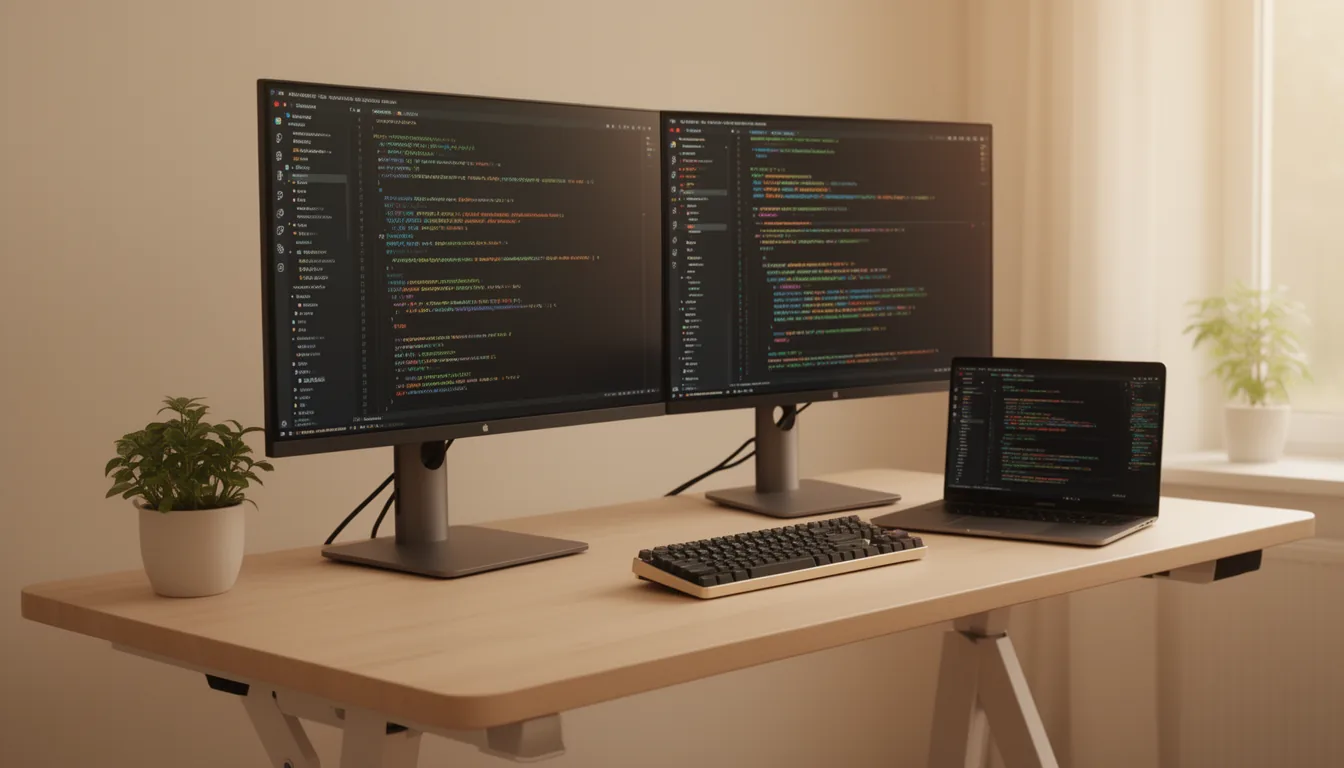
1. The machine: match it to your work
Dev priorities invert gaming: for most coding, cores and RAM matter more than a big GPU, which sits idle unless you do ML or creative work. Here's the RAM to target by workload:
Web/app coding, compiles and containers are CPU + RAM bound (a 16-core Ryzen 9 9950X flies through them); the GPU only becomes the priority for ML/CUDA, 3D and video. 2026 note: RAM is expensive right now - see our RAM guide.
- Web / app / backend dev — a 12-16 core Ryzen 9 9900X/9950X, 32-64GB RAM, a fast 2TB NVMe, and only a modest GPU (integrated is fine). Build it with our configurator.
- ML / AI dev — the GPU is the build. VRAM caps model size, so start from our best GPU for AI + VRAM calculator; pair with 64-128GB RAM.
- Video / 3D creator — cores and a big-VRAM GPU and fast, large storage. See best AI PC and best CPU.
The Mac option for developers
Plenty of developers prefer a Mac - quiet, efficient, and its unified memory doubles as VRAM for local AI (a Mac Studio can hold models a PC GPU can't). The current lineup, and which fits which job:
| Mac | Memory | Price tier | Best for |
|---|---|---|---|
| MacBook Air (M5, 13/15") | 16-32GB unified | Upper mid | Coding on the go, web/app dev |
| MacBook Pro 14 (M5 / Pro / Max) | 24GB base to 128GB | High | Serious coding + local ML on a laptop |
| MacBook Pro 16 (M5 Max) | up to 128GB | Workstation-class maxed | Local-LLM / video / 3D, portable |
| Mac mini (M4 / M4 Pro) | 16-24GB | Upper mid (Pro) | Cheap always-on dev desktop / CI |
| Mac Studio (M4 Max / M3 Ultra) | 36GB to 512GB | Workstation-class | Heavy local-LLM (512GB!), pro video/3D |
Laptops are on M5 (2026); desktops still M4/M3. We do not print prices; Apple raised them twice in 2026 - verify before buying. Deciding Mac vs PC for local AI? See our Mac vs PC and best AI PC guides.
2. The monitor
For coding, text sharpness beats everything - a 27-inch 4K USB-C hub monitor is the sweet spot, dual 27-inch 4K is the power setup, and Mac devs want 5K/6K. The full breakdown, the pixel-density chart and the picks are in our dedicated guide: best monitors for programming 2026.
3. Ergonomics: the desk that keeps you working
You'll spend more hours here than at any other machine you own. Get these right:
- Sit-stand desk — alternating positions cuts sedentary time (honestly: the benefit is alternating, not standing all day). Our standing desks guide has the picks; look for a quality actuator (premium desks use makers like Linak for smooth, quiet lift).
- Ergonomic chair — the Herman Miller Aeron (buying used saves a lot) or Steelcase Leap are the top tier; Branch, Sihoo and the Autonomous ErgoChair Pro (a popular, well-reviewed ergonomic chair) are the value picks. Check ergonomic chairs →
- Monitor arm — get the screen to eye level and reclaim desk space. The honest value tell: the Amazon Basics arm is made by Ergotron and nearly identical to the LX for a fraction of the price. Check monitor arms →
- Keyboard — a comfortable board for all-day typing; see our keyboards for programming.
- Mouse — a sculpted or vertical mouse (the Logitech MX Master 4 or MX Vertical) eases wrist strain over long days; see our best mouse.
- Bias lighting + a wrist rest — a light strip behind the monitor eases eye strain in dim rooms, and a memory-foam wrist rest is a cheap comfort win.
Frequently asked questions
Do developers need a powerful GPU?
Only for some work. For pure web, app and backend coding, compiling, containers and VMs, the GPU sits idle - you're bound by CPU cores and RAM, and integrated graphics or a cheap card is fine. You need a powerful, big-VRAM GPU if you do machine learning / CUDA, 3D (Blender/CAD + GPU render), or GPU-accelerated video export. Match the machine to the workload rather than buying a gaming GPU by default.
What's the best CPU for programming and development in 2026?
For dev work, cores and threads matter more than gaming's single-thread-plus-cache priority. The 16-core AMD Ryzen 9 9950X is a workstation chip that flies through parallel compiles, containers and rendering; the 12-core Ryzen 9 9900X is the value step below; Intel's Core Ultra 9 285K is the alternative where specific encode workflows help. That's the opposite of the gaming pick (an 8-core X3D) - see our best CPU for AI/dev and AMD vs Intel guides.
Is a Mac or a PC better for development?
It's two philosophies. A Mac's unified memory is one pool shared by CPU and GPU, so a Mac Studio can hold local-AI models a PC GPU can't fit in VRAM, and Macs are quiet, efficient and portable - great for web/app and iOS dev. A PC wins on raw VRAM ceiling, upgradeability and the CUDA ecosystem for ML. For pure coding either is excellent; for local LLMs it's a capacity-vs-speed trade-off covered in our Mac vs PC guide.
Which Mac should a developer buy?
For pure coding, a MacBook Air M5 (16GB) or a Mac mini M4 Pro on the desk is plenty. For local ML / large LLMs, unified memory is your 'VRAM', so a Mac Studio (up to 512GB) or a MacBook Pro 16 M5 Max (128GB) holds big models - and memory bandwidth, not the chip generation, decides local-LLM speed. For video/3D, a Mac Studio M4 Max/M3 Ultra with a Studio Display.
Is a standing desk actually worth it for developers?
The honest answer: the benefit is about alternating sitting and standing and cutting total sedentary time, not standing all day. Sit-stand desk studies (2024-25 reviews) show they reduce daily sedentary time by roughly 60-80 minutes and can help with chronic back pain - real, but not a magic calorie-burner. If you sit coding for 8+ hours, a sit-stand desk plus a good chair is a worthwhile health investment; just use both positions.
Sources & method
Workload-to-hardware guidance draws on our own CPU and GPU testing synthesis; the Mac lineup and prices are from Apple and retailer listings (laptops M5, 2026; desktops M4/M3; prices volatile after two 2026 hikes); the sit-stand evidence is from 2024-25 systematic reviews (reduced sedentary time, not calorie-burn); the Amazon-Basics-is-Ergotron and used-Aeron value tells are widely reported (Wirecutter, Forbes). We do not print prices — each machine carries an authored tier; specs are drawn from independent sources, cited across our linked guides. Last verified July 2026.
Related buyer's guides
All reviews →Productivity / Monitors
Best monitors for programming and development in 2026
For coding, text sharpness beats refresh rate. What actually matters (pixel density, a single-cable USB-C dock, a KVM), the honest dual-vs-ultrawide call, and the picks - from a 27-inch 4K workhorse to a 6K for Mac devs.
See the picks →
Tool / PC builds
PC build configurator: build a custom PC by budget
A free PC builder / computer configurator: enter a budget and get a balanced, compatible AMD or Intel gaming PC that never goes over it - swap any part with Change and it stays under budget. Instant, no sign-up.
Use the tool →
Buyer's guide / GPUs
GPU FPS benchmarks 2026: what FPS will you actually get?
The honest version: real rendered FPS with native separated from DLSS/FSR frame generation - because a '5070 = 4090' claim only holds with fake frames on. What current GPUs actually deliver, and how to match FPS to your monitor and build.
Read the guide →
Buyer's guide / Power supplies
Best PSU for gaming in 2026: the right wattage for your build
Bigger isn't better. The right power supply for each RTX 50 / RX 9000 build - the wattage you actually need, ATX 3.1 and the 12V-2x6 connector explained plainly, and how to make sure nothing melts.
See the picks →
Buyer's guide / Motherboards
Best gaming motherboards in 2026: B650 to X870E
The honest version: your chipset barely changes gaming FPS - a budget B650 games as fast as a flagship X870E on the same CPU. The right board for each build, when X870E is actually worth it, and why AM5 is the smart long-term socket.
See the picks →
Buyer's guide / PC cases
Best PC cases in 2026: airflow-tested picks for your build
The honest 2026 case guide that ties each pick to a real build - with stated GPU, cooler and radiator clearance, the fishtank-vs-mesh thermal truth, back-connect motherboard support, and the metal-tariff price reality.
See the picks →